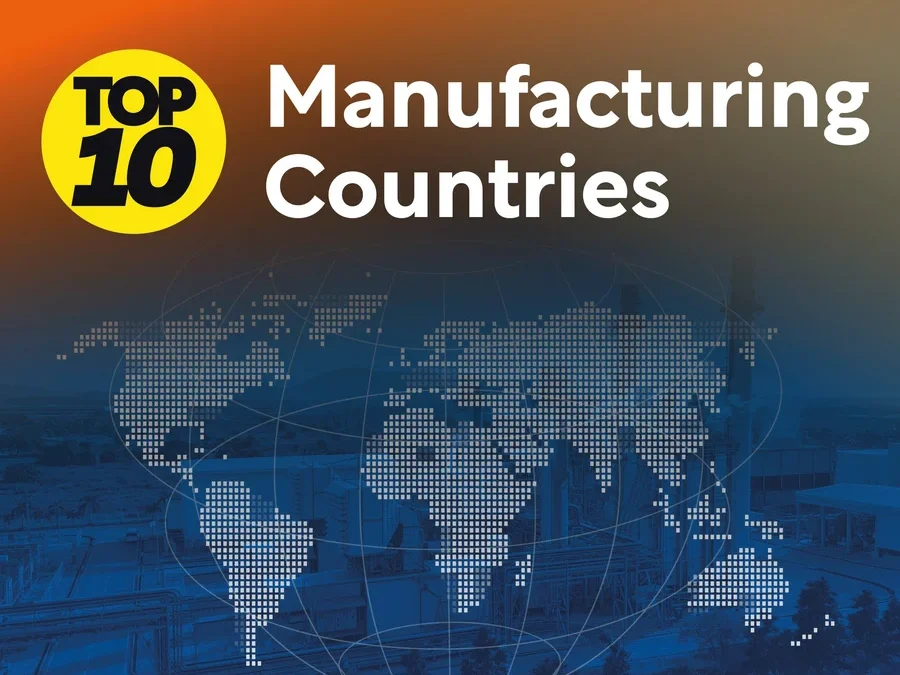
China’s dominance is undeniable, commanding nearly a third of global production, while the US and Japan maintain their traditionally strong positions through technological innovation and high-value manufacturing.
Germany’s engineering excellence remains a cornerstone of its industrial competitiveness, while emerging economies like India and Mexico are rapidly expanding their manufacturing footprints in new and innovative industry sectors.
Manufacturing Digital looks more closely at 10 of the top manufacturing countries, ranked based on percentage of global manufacturing output, providing a clear picture of where the world’s products are actually made.
10 | France
Percentage of global manufacturing output: 1.6%
Key companies: Airbus, L’Oréal, Schneider Electric
Key industries: Aerospace, pharmaceuticals, luxury goods
France’s manufacturing sector builds on a legacy of craftsmanship and industrial innovation, from luxury goods to aerospace engineering. The country is strongly represented in high-value sectors, particularly aerospace, pharmaceuticals and luxury products, and is an emerging player in nuclear technology and renewable energy equipment. The nation has a resilient manufacturing base that emphasises innovation and sustainability and is home to the likes of European aerospace giant Airbus, L’Oréal and Schneider Electric, a global leader in energy management and automation solutions.
9 | Mexico
Percentage of global manufacturing output: 1.7%
Key companies: Cemex, Grupo Bimbo, América Móvil
Key industries: Automotive, aerospace components, consumer electronics
Mexico has transformed itself into a manufacturing powerhouse through strategic proximity to the US market and competitive labour costs. The country is a leader in automotive manufacturing, aerospace components and consumer electronics, serving as a crucial link in North American supply chains. The nation has successfully attracted foreign investment while developing domestic capabilities, particularly in the automotive sector where it ranks among the world’s top vehicle producers. Key manufacturers based in Mexico include Cemex, one of the world’s largest cement companies, bakery company Grupo Bimbo and América Móvil, Latin America’s largest telecommunications company.
8 | Italy
Percentage of global manufacturing output: 1.8%
Key companies: Stellantis (Fiat Chrysler), Ferrari, ENI
Key industries: Industrial machinery, automotive, luxury goods
Italy is well known for its rich tradition of artisanal excellence combined with modern industrial capabilities, and has built its reputation on design, quality and innovation, particularly in machinery, fashion, and luxury goods. Italian manufacturers lead in industrial machinery, automotive components and high-end consumer products, and its sector is characterised by numerous specialised small and medium enterprises alongside major industrial groups. Notable Italian manufacturers include Fiat Chrysler Automobiles (now part of Stellantis), Ferrari and ENI, the multinational oil and gas company.
7| Russia
Percentage of global manufacturing output: 1.8%
Key companies: Gazprom, Rosneft, United Aircraft Corporation
Key industries: Energy equipment, defense systems, nuclear technology
Russia’s manufacturing sector is built on abundant natural resources and a legacy of heavy industry from the Soviet era, with the country a notable player in energy equipment, defense systems, and materials processing. Russian manufacturers dominate in oil and gas equipment, nuclear technology, and aerospace, leveraging the nation’s engineering expertise and resource wealth. Notable Russian manufacturers include Gazprom, the world’s largest natural gas company; Rosneft, one of the world’s largest oil companies; and United Aircraft Corporation, which produces civilian and military aircraft.
6 | South Korea
Percentage of global manufacturing output: 2.7%
Key companies: Samsung, LG, Hyundai
Key industries: Electronics, semiconductors, shipbuilding
South Korea’s rapid industrialisation transformed it from an agricultural economy to a manufacturing powerhouse in just decades. South Korean manufacturers excel in electronics, semiconductors, shipbuilding, and automotive production, competing at the highest levels of global markets. The nation has successfully transitioned from low-cost manufacturing to high-tech production, investing heavily in research and development and today is home to the likes of Samsung, LG and Hyundai.
5 | India
Percentage of global manufacturing output: 2.9%
Key companies: Tata Group, Reliance Industries, Bharti Airtel
Key industries: Pharmaceuticals, textiles, automotive components
India’s manufacturing sector has grown rapidly, supported by a large domestic market and competitive costs. Indian manufacturers are increasingly prominent in pharmaceuticals, textiles, automotive components and information technology hardware, with the nation’s strength rooted in its skilled workforce, growing infrastructure and diverse industrial base. The nation is becoming a key player in global supply chains, particularly for industries requiring both scale and technical expertise, driven by major companies including Tata Group, Reliance Industries, and telecoms company Bharti Airtel.
4 | Germany
Percentage of global manufacturing output: 4.8%
Key companies: Volkswagen Group, Siemens, BASF
Key industries: Industrial equipment, automotive, chemicals
Germany remains Europe’s manufacturing powerhouse, built on a foundation of engineering excellence and industrial innovation. The country’s manufacturing sector combines traditional strengths in machinery and automotive with cutting-edge technology and automation. Today, German manufacturers lead in industrial equipment, automotive, chemicals and precision instruments, setting global standards for quality and efficiency. Germany’s manufacturing philosophy emphasises long-term thinking, sustainability, and innovation – the “Industry 4.0” concept originated here, reflecting its leadership in smart manufacturing. Key German manufacturers include Volkswagen Group, Siemens and BASF.
3 | Japan
Percentage of global manufacturing output: 6.5%
Key companies: Toyota, Sony, Panasonic
Key industries: Automotive, electronics, precision machinery
Japan’s manufacturing sector is synonymous with quality, efficiency, and innovation – the country pioneered lean manufacturing principles and continuous improvement methodologies that have been adopted worldwide. Japanese manufacturers lead in automotive, electronics, precision machinery and advanced materials, as well as sectors such as robotics, electric vehicles and advanced manufacturing techniques. The company is home to major international manufacturers including Toyota, the world’s largest automaker by production, Sony and Panasonic.
2 | United States
Percentage of global manufacturing output: 15.9%
Key companies: Boeing, General Motors, General Electric
Key industries: Aerospace, pharmaceuticals, advanced machinery
The US built the modern manufacturing template during the Industrial Revolution and remains a dominant force despite decades of offshore production. US manufacturers lead in aerospace, pharmaceuticals, advanced machinery and technology products, leveraging innovation and scale advantages. The country’s manufacturing renaissance has been driven by automation, reshoring trends and energy cost advantages from domestic oil and gas production, with modern US manufacturers benefitting from strong research institutions, venture capital access, and large domestic markets. Leading US manufacturers include aerospace and defence giant Boeing; General Motors, one of the world’s largest automakers; and General Electric, an industrial leader in aviation, healthcare, and energy.
1 | China
Percentage of global manufacturing output: 31.6%
Key companies: Foxconn, BYD, China National Petroleum Corporation
Key industries: Electronics, steel, renewable energy equipment
China has become the undisputed manufacturing leader through unprecedented scale, investment and rapid capability development. The country’s manufacturing rise began with labour-intensive assembly but has evolved to encompass virtually every industrial sector. Chinese manufacturers now lead in electronics, textiles, steel, chemicals and increasingly in high-tech sectors like renewable energy equipment and electric vehicles. The nation serves as both the world’s factory and a massive domestic market, creating unique advantages for manufacturers. China’s manufacturing success stems from infrastructure investment, supply chain integration and government industrial policies. Major Chinese manufacturers include Foxconn, the world’s largest electronics manufacturer; electric vehicle and battery producer BYD; and oil and gas firm China National Petroleum Corporation.
Publicado originalmente por: https://manufacturingdigital.com/top10/top-10-manufacturing-countries
Comentarios recientes